
The climate crisis is increasingly manifesting itself through health impacts that affect productivity, costs, and business continuity. According to a new report from the World Economic Forum, climate-related health impacts could translate into at least $1.5 trillion in lost productivity by 2050 in the food and agriculture, built environment, and health and healthcare sectors. For businesses, putting health at the center of resilience is no longer a “nice to have,” it’s risk management. World Economic Forum
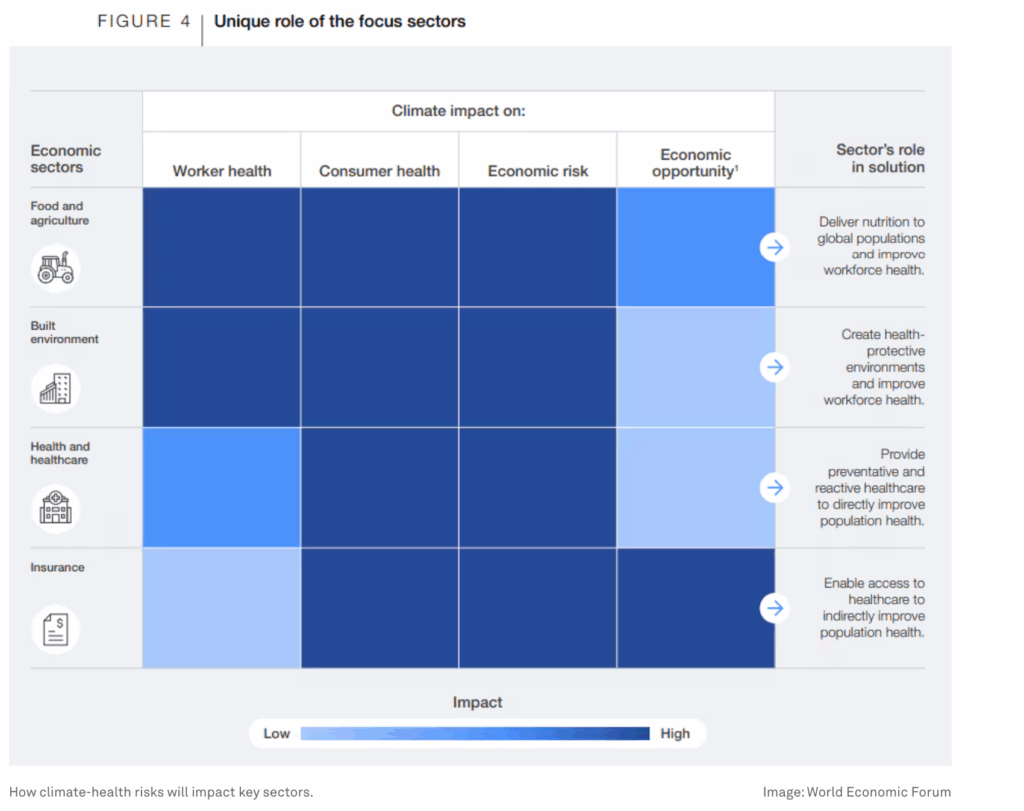
The Most Exposed Sectors (2025–2050)
Food & Agriculture – Extreme heat, water stress, and vector-borne diseases will reduce labor availability and yields in primary supply chains, with estimated losses of $740 billion. Expected impacts: crop disruptions, price volatility, and nutritional risks for workers. WEF Reports
Built Environment (construction and building management) – Outdoor workers and construction sites in hot urban areas will suffer at least $570 billion in productivity losses due to heat illness, illness, and injury. Expected impacts: project delays, rising insurance costs, and OPEX.
Health & Healthcare – In addition to pressure on personnel and facilities, the sector could face at least $200 billion in lost output and up to $1.1 trillion in additional treatment costs by 2050. Drivers: heat waves, water- and vector-borne diseases, malnutrition, and an increase in chronic diseases (asthma, diabetes, and cardiovascular disease).
The “Dangerous Gap” in Adaptation Financing
Less than 5% of global climate adaptation financing is directed at health protection: a dangerous gap and, at the same time, an opportunity for innovation and competitive positioning for companies that fill the gap.
- Business Impacts Along the Value Chain
- Productivity and Absenteeism: Reduced hours worked, increased shifts, and replacement costs.
- Supply Chain: Simultaneous shocks in critical regions (heat waves, floods) and increased lead times.
- CAPEX/OPEX: Increased spending on insurance, cooling retrofits, air quality, and water protection.
These trends add to macroeconomic scenarios that indicate economic damage far greater than historical estimates, strengthening the business case for proactive adaptation.
Reuters
What it means for leaders
In my experience, the real lever is shifting from “climate compliance” to human capital health resilience. Companies that map climate-related health risks at the site/role level and invest in scalable solutions (cooling, hydration, healthier foods, resilient buildings, AI-powered monitoring) protect their margins and reputation and gain a competitive advantage in B2B and B2G markets.